

For the last few years, AI adoption has centered on getting people to use AI. Adoption programs rolled out access and training to get people started. Those steps remain the foundation, and plenty of teams are still building it.
Once people use AI regularly, the picture changes. AI can produce a competent first answer on its own, and what it handles well keeps changing as models change. Leaders then face a different question: where does human judgment make the result better?
A polished AI output can hide very different levels of judgment. One reviewer tightens the language in a recommendation. Another catches an unconfirmed assumption that could change the decision. Leaders need a way to see that difference.
Adding Value Beyond What AI Produces
Research from KPMG and the McCombs School of Business at UT Austin gives us a useful way to think about this (KPMG's summary of the study). The researchers studied 523 US-based early-career KPMG professionals completing tasks with an AI agent that closely matched the client assignments they'd normally handle. First, they had the AI complete each task on its own. Then they measured how each person performed working with that same AI and compared the results to the AI-only version.
Many AI studies ask whether people perform better with AI. This study asks whether people can improve on what AI produces by itself.
Half the Group Beat the Baseline
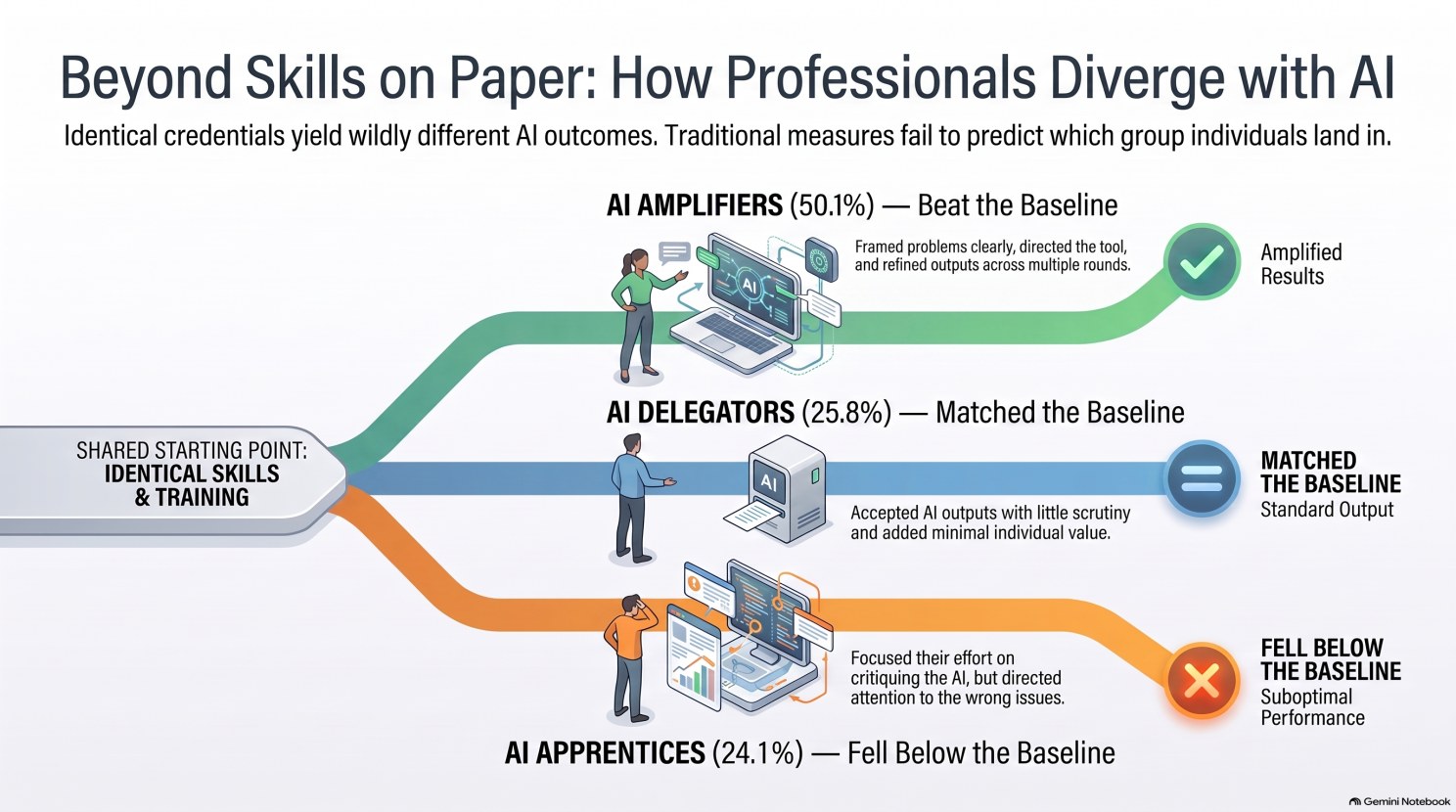
Just over half the participants (50.1%), called AI Amplifiers, beat the baseline. The rest split almost evenly between AI Delegators (25.8%), who matched it, and AI Apprentices (24.1%), who fell below it.
Traditional measures of capability didn't explain the gap. People who beat the baseline looked nearly identical on paper to those who fell short.
Apprentices show this clearly. They matched Amplifiers on every foundational skill the study measured and still finished below the baseline, often critiquing the AI on the wrong issues. The difference came down to when and how each person stepped in.
Moving From Human in the Loop to Human in the Lead
Human in the loop covers a wide range, from oversight throughout a process to a quick sign-off at the end. The sign-off version shows up often. It puts the person at the end of the process, reacting to whatever AI produced.
I prefer human in the lead. A person in the lead sets direction before AI runs and decides when the result is ready to move on.
The research supports this. KPMG found that performance came down to how well people directed AI and judged what it produced. Amplifiers showed those behaviors, framing problems to guide the AI and anchoring the output in real domain frameworks before refining across several rounds.
Apprentices led too, in the wrong direction. Their challenges pointed the AI at issues that didn't matter, which pulled their results below the baseline.
Leading also means knowing when to leave an answer alone. A sound result doesn't need three more rounds of prompting to prove someone contributed. The reviewer who caught the unconfirmed assumption led well. She found the issue that mattered and left the rest of the recommendation alone.
In a recurring process, many of these leadership points can be identified in advance. Some come before AI runs, and others come between the first output and the version that goes downstream. Leaders can name them and build them into the process, so everyone knows where they're expected to lead.
Run Your Own Baseline
Leaders want to know what human attention adds to an AI-supported process. The study's design gives you a way to find out.
Pick a recurring task and several representative examples, and agree on the criteria before you compare anything. For an analytical brief, those include factual accuracy, relevance to the decision, support for the recommendation and clear flags on uncertainty.
Run each example with AI alone, using the same brief and sources your people get. Have reviewers rate the AI-only outputs and your team's outputs together against the agreed criteria, without knowing how each was produced. Then compare the ratings. Count the contributions a side-by-side misses too, such as a critical figure someone verified and left unchanged.
A team exercise runs looser than a controlled study, and its purpose is practical. It surfaces where people improve results and where an intervention deserves a closer look. Treat it as a development tool for spotting those opportunities.
The baseline also shifts as models change. A new release can change what AI handles well, sometimes improving a task and sometimes introducing new problems. Rerun your comparison whenever your models change, so you know what's different.
Turn Good Judgment Into a Team Capability
How can we use this research to help people with adoption? Start by developing judgment in individuals, then build what you learn into how the team operates.
Treat the three groups as descriptions of behavior on a task. Someone can lead well in a familiar process and struggle to judge an answer in a new domain.
For Apprentices, the goal is to stop steering AI the wrong way. I've seen buddy pairing work on client teams. Applied here, the baseline comparison helps identify pairs: someone whose interventions pulled results down, working alongside someone who beat the baseline on that task and can explain their decisions. When the pair reviews the same output and tests each change against the task's purpose, the result shows which change mattered.
In the study, Delegators accepted AI output with little scrutiny (KPMG). They need a different habit: checking output against the task's criteria before passing it along. Accepting AI output after that check is good judgment, and some tasks need nothing more.
Everyone benefits from learning built into the team's regular rhythm. A standing meeting slot gives someone room to walk through one AI-assisted decision that mattered, including the times more editing added nothing.
The second level moves beyond individuals. When a strong performer explains why they stepped in, capture the reason along with the move. A context brief and a set of review criteria tied to the task's purpose turn one person's judgment into shared material. Add an example of a plausible answer that missed something important, with a note on how the reviewer caught it. Where your team has builders maintaining shared AI tools, bring them in so recurring context and common misses land in the tools themselves.
Keep Reexamining Where People Lead
A model change can move the points where people need to lead. Take an analyst who reviews a recurring report. Early on, she spends her attention correcting summaries and checking calculations. Once the system handles those steps reliably, her attention moves to investigating exceptions and deciding what the findings mean for the business. Her contribution changed because the baseline did.
One-time skills training treats the capability gap as something you close once. Leaders who keep rerunning the comparison will know where human judgment matters today and where it's moving. Capturing why people step in lets the whole team move with it.
If you're working out where people should lead in your AI processes, or how to keep that picture current, I'd love to compare notes. Reach out.
Source: KPMG, “Shaping Early-Career Success in the Age of AI,” July 23, 2026, summarizing a KPMG and University of Texas at Austin study published in Harvard Business Review.