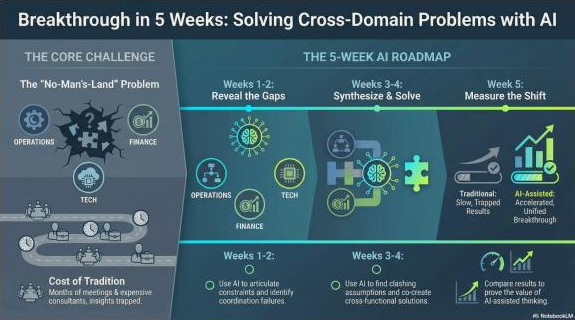
Cross-domain problems are expensive. They're the strategic questions that sit between operations, finance, programs, technology, and external stakeholders. Everyone agrees they matter, but no one fully owns them. Progress depends on multiple teams aligning before anything can move forward. Most organizations handle these problems in predictable ways. They schedule months of meetings to coordinate perspectives.
Or they bring in consultants to do the synthesis work. Both approaches are slow. Both are costly. And both leave insight trapped inside silos until someone manually connects the dots. AI changes what's possible here. Not by replacing anyone's expertise, but by helping teams see the whole problem at once instead of in pieces. Here's a five-week structure teams can use to tackle a real cross-domain problem together, with AI as support.
Not to move faster, but to work differently and surface insights no single person could generate alone.
Week 1: Find where your silos are costing you
Most teams know they have cross-domain problems. They just haven't made them explicit. Each person answers three questions independently. Use AI to help you get your thoughts out of your head and onto the page. What decisions are we making slowly because they require input from multiple departments? What problems keep resurfacing that no single team owns? What customer, constituent, or market issues do we discuss but never resolve because they cross organizational boundaries?
Open your AI assistant. Give it context about your role and team, then work through the questions.
Example prompt
“I lead operations at a mid-size organization. We work closely with finance, delivery teams, technology, and external partners. Help me think through decisions we're making slowly because multiple teams need to align.” AI will start with general examples. Push it to get specific. “We've been debating whether to expand a program. Walk me through what coordination that actually requires and where things usually slow down.”
As you do this, patterns you've been dealing with for years become obvious. Use the tool to help you name issues you've felt but haven't fully articulated. Give yourself about 30 minutes. This doesn't need polish. It needs clarity. Someone from another team should be able to read it and understand what you're experiencing without you in the room. Then bring everyone's answers together.
Where responses overlap, you'll see the real problem you've been talking around. Where they diverge, you'll see perspective gaps that have likely been slowing decisions for years. Pick one problem that shows up across multiple responses. That's your focus for the next four weeks.
Week 2: Each team writes down their perspective
Each group works on its own with AI to write down how the problem looks from where they sit. Operations explains capacity, constraints, and execution realities. Finance lays out budgets, funding restrictions, cost drivers, and risk exposure. Delivery teams describe what's actually happening day to day and where friction shows up. Technology / Data explains system limitations, data quality issues, and dependencies.
External-facing teams surface stakeholder expectations and pressure points. Use AI to help organize what you already know and what you're worried about. Ask it to surface assumptions other teams may not see. Give each group about an hour. The output should be two to three pages that someone outside the function could read and actually follow. At the end of the week, put everything in one place—a shared document or workspace where the full context lives together.
Week 3: See the whole problem at once
This is the shift. Walk through all of the write-ups with AI. Don't ask it to solve the problem. Ask it where things clash, where teams are unknowingly blocking each other, and where something new might be possible once you see everything together. Explore questions like: Where does one team's constraint create problems for another? Which assumptions don't line up?
What tradeoffs are being made without anyone realizing the downstream impact? Where are there opportunities no single team would see on its own? No decisions get made here. The goal is to understand what's really happening before anyone starts arguing for a solution. Do this live, together. One person runs the conversation. Everyone else reacts and takes notes.
Pay attention to what surprises you and what questions emerge that you've never asked before.
Week 4: Make sense of it together
This is where the team's experience and judgment matter. Use what surfaced to build recommendations. Use AI to help organize thinking, explore options, and stress-test ideas against each team's constraints. Ask: What changes address root causes instead of symptoms? Which ideas hold up once you look at them from every angle? What would need to be true for this to work in the real world?
AI helps keep the full context in view. The team decides what's viable. Write down why you landed where you did. What tradeoffs are you accepting? What risks remain?
Week 5: Compare this to how you normally work
Take an honest look at what just happened. How long would this have taken using your usual approach? Would you have even attempted it? What did you learn that you wouldn't have discovered otherwise? Could any one person have produced this recommendation alone? Could they have even seen the full problem? If what you produced is better than what you usually end up with, that tells you something important about how your team can work.
If it's not, that's useful information too. Either way, you now have evidence—not opinions—about what AI enables for your team.
What this changes
Cross-domain problems are hard because synthesis is hard. Alignment is hard. Maintaining context across teams is hard. AI doesn't make expertise less important. It makes it easier to bring that expertise together without everything grinding to a halt. Over time, you're not just solving one problem. It's about getting better at working across boundaries instead of defaulting to endless meetings or outside help.
This five-week structure makes it visible whether a team can actually do that. One real problem. Short window. Clear evidence of what changes when AI becomes part of how teams think together. Try it with a real problem you've been stuck on. See what changes.
Want help running this with your team?
I work with enterprise organizations to tackle cross-domain problems that have been stuck for months. If you're ready to try this approach with a real issue, reach out.