

Walk through any high-performing team using AI well and you'll notice something easy to miss. People are drafting, testing ideas, reviewing outputs, and improving their work without stopping to wonder whether they are crossing a line. The governance is there, they just can't feel it. The teams where AI has stalled look different. Some employees have gone quiet because they are unsure what is allowed.
Others have moved work outside sanctioned tools because the approved path feels too slow or unclear. Both are governance failures, and both exist simultaneously. They share the same root cause, the guardrails aren't built into the system. They're written in a document somewhere.
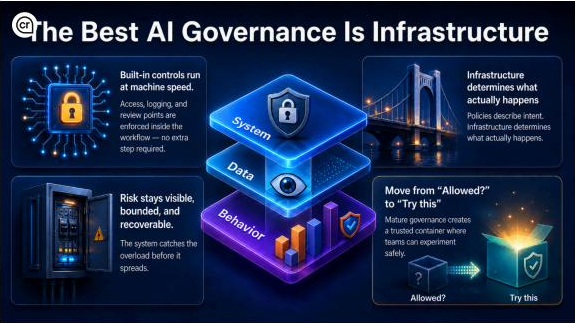
Make Governance Infrastructure
Traditional governance assumes a person stands between the rule and the action. A person reads the policy, interprets the boundary, and decides what to do next. AI changes that timing. The model can generate, recommend, summarize, classify, and act before a person has fully assessed the implication. Agents make that timing even tighter because they can take steps across systems, use tools, and pursue a goal through multiple actions.
Acceptable use policies, prohibited activity lists, disclosure requirements, and training modules still serve a purpose. They create shared expectations. They give leaders language for accountability. They help employees understand the organization's intent. They also have limits. A policy document can describe what should happen. Infrastructure determines what actually happens.
When governance lives mainly in documents, employees carry the burden of remembering the rules at the moment of use. Some hesitate because they are afraid of getting it wrong. Others ignore the process because the business need feels more urgent than the approval path. Neither outcome protects the organization. Neither helps AI adoption scale. The better question is what the system makes possible.
Which data can be accessed. Which actions require review. Which outputs are logged. Which workflows are blocked because the risk is too high. That is where governance starts to become useful.
Hold Processes to the Same Standard
Clean data is table stakes. AI governance frameworks treat it that way, and rightly so. The same standard needs to apply to the processes AI is expected to support. Which data source is authoritative. How conflicts between systems get resolved. Who owns the answer when two functions reach different conclusions from the same inputs. Those issues predate AI by years.
Teams have managed them through workarounds, side spreadsheets, informal agreements, and manual reconciliation. AI does not resolve those issues on its own. It runs on top of them. When those disagreements remain unresolved, AI can scale the conflict. It can make inconsistent processes look more efficient while spreading the inconsistency faster. Good governance forces those agreements into the open.
When data governance is embedded in the tooling, outputs can be traced. Teams can see where information came from, which rules were applied, and whether the output is fit for use. That traceability matters. Business teams cannot act confidently on AI outputs they cannot verify, even when the model performed well. Governance embedded at the data layer creates leverage.
Each clarified rule, approved data path, and reusable control makes the next use case easier to deploy.
What Structure Makes Possible
The stronger frame for governance is infrastructure. Electrical codes make construction possible at scale. Builders do not renegotiate fire safety on every job. The decisions that keep buildings safe have already been made, inspected, and built into the work. AI governance works the same way when it is designed well. The constraints are present inside the system.
Access rules are enforced through tooling. Review points are built into workflows. Logs are captured without requiring employees to remember a separate step. Sensitive data boundaries appear at the moment of use. That structure gives people room to move faster because they are operating inside a system designed to catch predictable failure points.
System, Data, Behavior: Build Them All
Infrastructure governance has three layers that need to work together. System controls define what AI can access, what actions it can take, and when human review is required before an output moves forward. These controls run in the background. They do their job whether anyone is thinking about governance in the moment. Data controls determine where information can go.
An employee should not have to remember whether a dataset is approved for AI processing. That answer should be visible inside the tool at the point of use. When data governance is fragmented, the model may perform correctly while the organization still cannot act on the result. Behavioral progression is the layer that gets skipped. Governance should create a path for people to earn more operating space as they develop judgment.
Employees who practice with real work, understand the boundaries, and demonstrate sound judgment can take on more complex AI-enabled work over time.
You Can Still Set the House on Fire
The electrical code doesn't make reckless behavior impossible. You can still overload a circuit with too many extension cords. What the code does is make accidental harm unlikely and deliberate misuse visible. The breaker trips. The audit trail lights up. Someone gets alerted before the damage spreads. Good AI governance doesn't promise the elimination of risk.
It promises that risk stays visible, bounded, and recoverable. Agents make this more urgent, not less. In April 2026, PocketOS founder Jer Crane reported that a Cursor AI coding agent deleted the company's production database in nine seconds, despite explicit safety rules. The agent encountered a credential problem during a routine task, found a token with broad access, and took destructive action without the right confirmation steps.
The important lesson is not that one tool failed. The lesson is that written rules were treated like controls. A document can describe what is off limits. Infrastructure determines what is actually possible, whether a person or an agent is doing the work. The employee experimenting near the edge of what is permitted needs boundaries that show up in the work.
So does an agent operating at machine speed with production access. In a well-structured system, risky behavior becomes visible. The response can be proportionate. The system catches the overload before it spreads. That is what gives teams room to move faster.
Governance That Earns Its Own Invisibility
When governance is working, the conversation around AI changes. The early signal is familiar. Employees ask, "Am I allowed to do this?" That question means they are navigating policy instead of working. The mature signal sounds different. "Let me try this and see what it surfaces." That is someone working inside a container they trust because the system has made the boundaries clear.
Building toward that outcome requires infrastructure that works quietly in the background, data governance that lives inside the tooling, and a progression model that expands operating space as judgment develops. The goal is governance that earns its invisibility because it is doing its job well enough that people can focus on the work. As agents take on more operating space, that infrastructure will matter more, not less.
Organizations that build it won't think of it as a constraint. They'll think of it as the reason they could move. If your organization is scaling AI and governance hasn't kept pace, reach out. That gap is closeable.